The SWOT Isn't Broken. You Are Using It Wrong.
I was scrolling through the output of a new AI business planning tool a few weeks back, the kind that promises to turn a five-minute chat into a bank-ready plan. It had built a sample plan for a boutique hotel, complete with an NDA template, a term sheet, and an SBA-format financial summary. Genuinely slick. Somebody on that team can clearly build software, understand what a lender wants to see, and get a product to market.
Then I got to the SWOT slide.
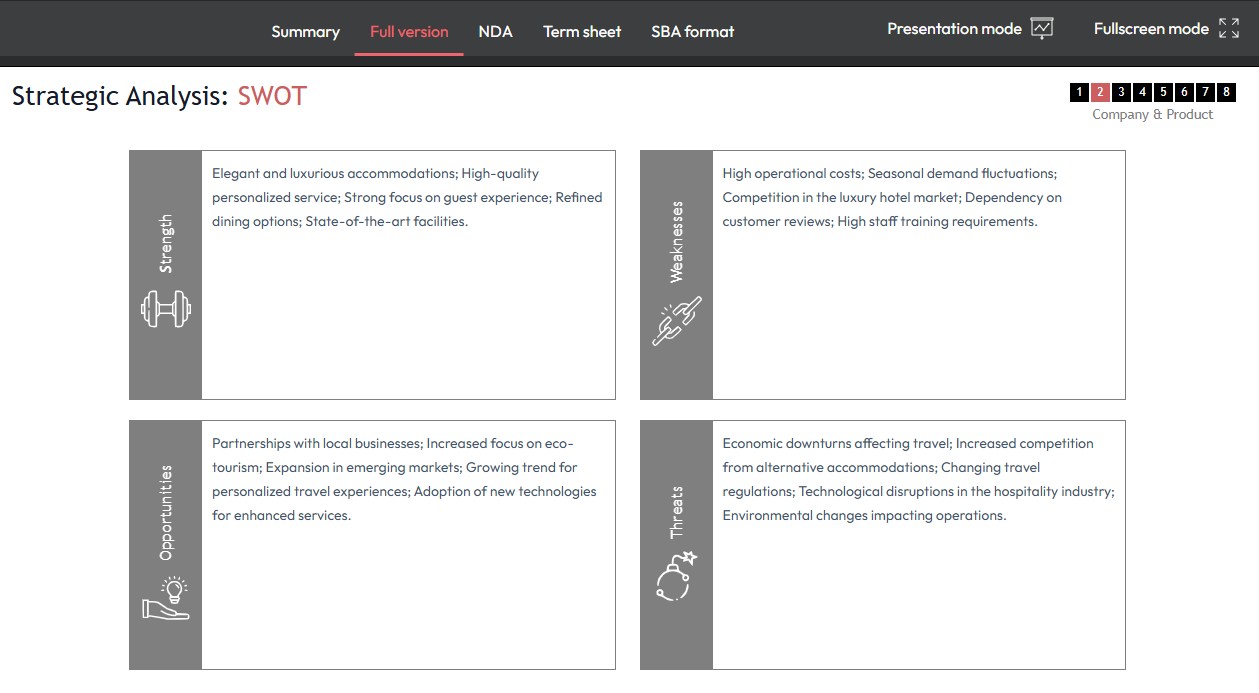
Under "Weaknesses" it listed seasonal demand fluctuations. Under "Opportunities" it listed the adoption of new technologies for enhanced services, the growing trend for personalised travel, and expansion into emerging markets.
I closed the laptop. Not because the tool is useless — it may not be, for a narrow set of tasks — but because whoever built that slide does not understand the one framework in the whole plan that a first-year MBA student is expected to get right. And they are not alone. In the years I spent teaching this stuff at MGSM and UOW, I watched competent, experienced managers make exactly this mistake, over and over, in rooms with far more at stake than a demo deck.
The SWOT gets dismissed as old hat. Something you did once in a workshop with sticky notes and never looked at again. That reputation is deserved, but not for the reason people think. It isn't dated. It's misused — so consistently, and in such predictable ways, that I can usually tell within thirty seconds of looking at someone's SWOT whether the rest of their plan is going to be any good.
Here is what almost everyone gets wrong, and what doing it properly actually looks like.
Mistake one: opportunities become a wish list
Ask a room full of managers to fill in the "Opportunities" box and watch what happens. Someone mentions a trend they read about. Someone else mentions something a competitor is doing. A third person mentions the thing they've personally wanted to build for two years and has been looking for an excuse to raise. Within ten minutes the box is full of ideas that have nothing in common except that somebody in the room likes them.
That's not an opportunities analysis. That's a suggestion box with better formatting.
An opportunity, properly defined, is something your strengths make possible. It's not "what's out there that sounds good" — it's "given what we're actually good at, what can we now go and get that we couldn't otherwise?" A hotel with elegant, personalised, high-touch service and a well-trained staff has an opportunity to command a premium in a segment that a budget operator, however well-run, structurally cannot chase. That's a real opportunity: it's derived, it's specific, and it points straight at an action.
"Adoption of new technologies for enhanced services" is not that. It's not derived from anything in the Strengths box above it. It's not even really about the business — it's a category of things that exist in the world, restated as if identifying a trend were the same as having a strategy for it. Every hotel on earth has this "opportunity." Which means, properly understood, none of them do.
The discipline is simple to state and hard to hold to under time pressure: don't fill in Opportunities until Strengths is genuinely done, and then only write down what a strength enables. If you can't trace an opportunity back to a specific strength above it, delete it. It's a hobby horse wearing a strategy costume.
Mistake two: internal and external get blurred
This is the one that should worry you more, because it's subtler and it corrupts everything downstream.
A SWOT has a spine running through the middle of it that most people never notice: Strengths and Weaknesses are internal — things about your business that you, in principle, have the power to change. Opportunities and Threats are external — things about the world that you don't control and mostly can't. Blur that line and the whole tool stops working, because the action plan that's supposed to fall out the other end no longer points at anything you can actually do.
Back to the hotel. "Seasonal demand fluctuations," sitting in the Weaknesses box. Read it again. Is that a weakness of the business — or is it a fact about the world the business operates in? Nobody at that hotel, however brilliant, is going to fix the seasons. That's not a weakness. It's a threat, or more precisely a condition the business exists inside. Filing it as an internal weakness means the plan now contains an action item that translates, in practice, to "get better at not controlling the weather."
What's the actual internal weakness hiding behind it? Something like: the property has no facilities, programming, or positioning that gives anyone a reason to travel there outside peak season. That is something the business can fix. It might mean building a conference and events space that fills shoulder-season weekdays. It might mean a wellness retreat package aimed at a demographic that travels off-peak on purpose. Whatever it is, it's an action a general manager can put a name and a budget against — which is the entire point of doing the analysis in the first place.
Every time I see this mistake, I see the same downstream failure: an action plan full of things nobody can execute, because half of it is aimed at the weather.
Mistake three: symptoms get filed as causes
Related, and just as common. "High operational costs" as a weakness. "Dependency on customer reviews" as a weakness. Both true, both measurable, both almost useless as written, because neither one tells you what to do next.
High operational costs relative to what? Because of what? Ask "why" once — the way a decent five-year-old interrogates literally everything, to everyone's eventual exhaustion — and you usually land somewhere specific: over-staffed for actual occupancy, or a supplier contract nobody's renegotiated in three years, or a facility that's expensive to run because it was designed for a different era of guest expectations. That's a weakness you can act on. "High operational costs" on its own is a symptom wearing a diagnosis's clothes, and a manager who writes it down and moves on has done the paperwork without doing the thinking.
Same test for every line in the Weaknesses and Threats boxes: is this the actual thing, or is it the shadow the actual thing is casting on the wall? If your action plan reads back to you as vague as the symptom you started with, you stopped one "why" too early.
Putting it back together: the SWOT is half a tool
Here's the part almost nobody gets to, and it's the reason the SWOT has such a poor reputation among people who've only ever seen it done badly: a SWOT that just lists four boxes and stops was never finished. Filling the boxes is data collection. The actual analysis — the bit that earns the exercise its name — is what you do next, cross-referencing one box against another. Practitioners call this the TOWS step, and most people who ran the workshop have never heard of it.
Once your four boxes are honest — opportunities genuinely derived from strengths, weaknesses genuinely internal, causes rather than symptoms — you go back through and ask four questions:
Where does a strength let us go after an opportunity directly (an SO strategy)? Where does a strength let us neutralise or absorb a threat (ST)? Where does an opportunity exist that we can't reach yet because of a specific weakness, meaning the weakness is now worth fixing (WO)? And where does a weakness leave us exposed to a threat badly enough that it's a genuine survival risk, not just an inconvenience (WT)?
That cross-referencing step is where the actual strategy lives. The four boxes, on their own, are just an inventory. Most SWOTs I've reviewed — in classrooms, in boardrooms, and now apparently in AI-generated business plans — never get past the inventory. They stop exactly where the useful part was about to begin.
What this costs you if you skip it
None of this is academic throat-clearing about frameworks for their own sake. Get the SWOT wrong in these specific ways and the plan built on top of it inherits every flaw. Your marketing spend chases an "opportunity" nobody's strength actually supports. Your operations team gets handed an action item aimed at something as immovable as the seasons. Your board signs off on a strategy that reads well in a slide deck and does nothing when it meets a trading week.
I have a narrow, specific use case for parts of a formal business planning process, and I'll be honest that a good chunk of what these AI tools generate is redundant for what I actually need, or simply wrong in the way I've just described. That's a separate argument. But the SWOT complaint isn't really about AI tools at all — it's about a discipline that's been sliding for as long as I've been teaching it, long before any of these tools existed. The software just makes the mistake scale faster and look more convincing while it does it.
Do it properly and the SWOT stops being the slide everyone skims past on the way to the "real" strategy. It becomes the reason the rest of the plan holds together. In the hands of a fool, it's a blunt instrument. In the hands of a craftsman, it's still one of the sharpest tools in the drawer — which is precisely why it's worth doing right, and precisely why so few people bother.


