How to Time Your Next AI Purchase (So You're Not Part of the 95% That Fail)
Every second SME conversation right now starts the same way. Should we be doing AI? What are our competitors doing? Are we falling behind?
Before answering any of that, look at what happened to the businesses that already tried.
The number nobody puts in the case study
MIT researchers examined three hundred AI deployments across large organisations in 2025, backed by interviews with 150 business leaders. The average company spent $1.9 million on generative AI initiatives that year. Fewer than one in three of their CEOs were satisfied with the return. Ninety-five per cent of pilot projects never made it to production.
These are companies with real budgets, dedicated implementation teams, and IT departments whose job is precisely this kind of rollout. If they can spend that much and still land in the 95%, the AI tool being sold to you off the back of a webinar or a cold email deserves more scrutiny, not less.
Why this keeps happening: the hype cycle
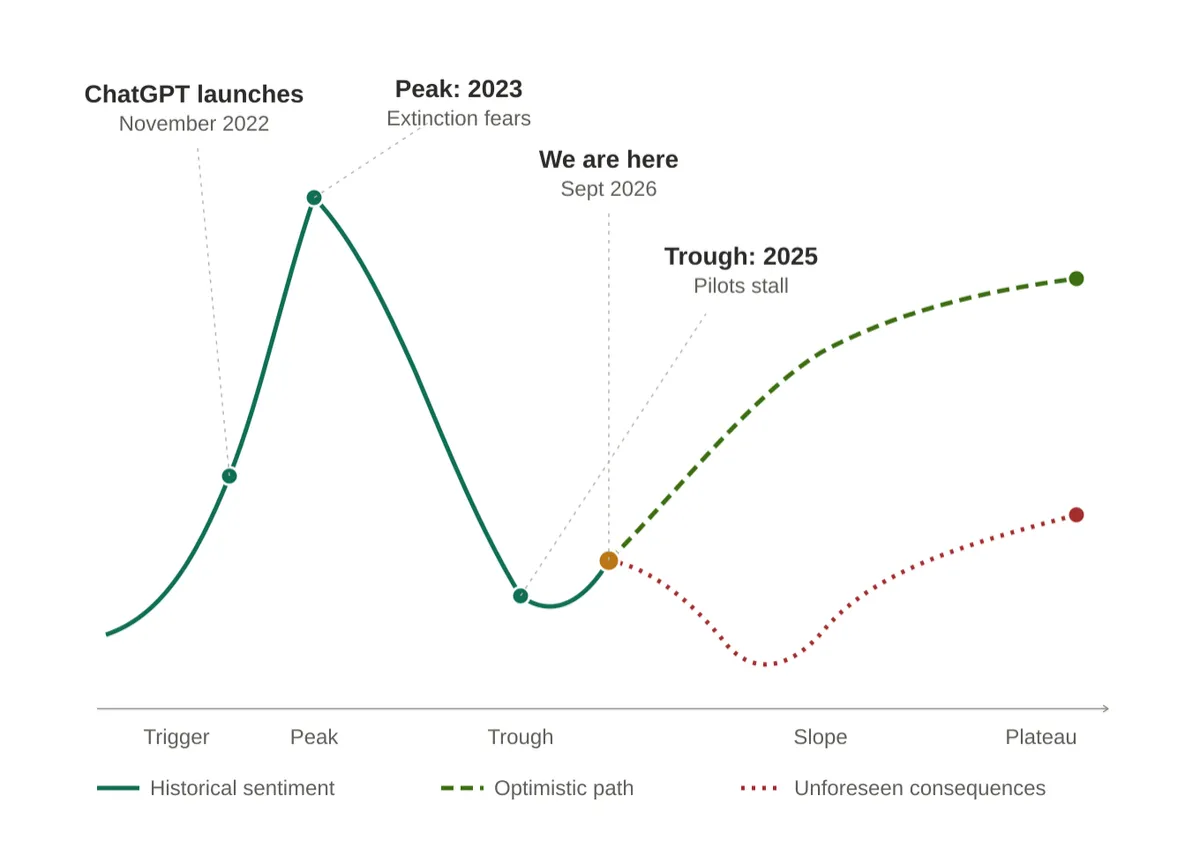
There's a well-established model for this, first drawn up by Gartner analyst Jackie Fenn in 1995, and it explains almost exactly what's happening right now. New technologies move through five predictable stages: a trigger, where the capability first breaks through; a peak of inflated expectations, where coverage runs far ahead of what anyone can reliably deploy; a trough of disillusionment, where the gap between the sales pitch and the operational reality becomes obvious and budgets get pulled; a slope of enlightenment, where the survivors work out what the technology is genuinely good for; and a plateau of productivity, where it finally becomes boring, dependable infrastructure.
By Gartner's own 2025 assessment, generative AI is sitting squarely in the trough right now. That matters for timing. A lot of what's currently being marketed to small business owners as "proven" and "essential" is still peak-of-hype product, repackaged to look like slope-of-enlightenment maturity.
The part that actually catches SMEs out
Here's the detail that gets missed in most of the AI-adoption advice doing the rounds: the tool can work exactly as advertised and still cost you money.
Say it genuinely saves fifteen hours a week on admin, scheduling, or follow-up. That's not automatically good news for your bottom line. It's a test of whether your business has a plan for the capacity it just freed up. Without that plan, the hours tend to evaporate into more admin, more scrolling, more meetings, while the subscription keeps billing regardless of what you did with the time it bought you.
The tool succeeding and your margin not moving are not a contradiction. They happen together more often than most vendors would like you to know.
A four-step framework before you sign anything
Know your baseline first. You can't measure the impact of a new tool against numbers you don't already have. Margins, hours spent per task, current cost per customer, current business valuation, whatever the tool claims to move, measure it before you sign, not after.
Locate the tool on the curve. Ask the vendor directly how long the product has been in market, and ask for a reference customer of your own size, not an enterprise case study three tiers above you. A confident answer is a good sign. A dodge is the real answer.
Cost the capacity, not just the software. Work out, in writing, what you'll actually do with the time or headcount the tool frees up. If there's no answer to that question, there's no case for the purchase yet, regardless of the subscription price.
Set a 90-day kill date. Decide now, before you're emotionally or financially invested, what result by day 90 means you keep it, and what result means you cancel. Write it down. Most failed pilots didn't fail loudly, they just never got reviewed against anything.
Where SME Baseline fits
This is exactly the gap SME Baseline was built to close. Before you spend the next dollar chasing the AI hype cycle, get a clear baseline on your margins, your operational capacity, and what your business is genuinely worth today. That baseline is the number you hold every vendor to, in this cycle and the next one.
Don't buy at the peak. Get your baseline first.


